The well publicised climate change effort to drive our carbon footprints lower through supply chains means that for ourselves, customers, suppliers and partners we have to make changes in the way we do business. The paper here was written by our marketing director and published in the Aberystwyth Business Review. It details a simple process for helping companies to drive business sustainability through an environmental sustainability focus.
How can the drive to Net Zero help the economic stability of your business?
Dr Julie Jones Aberystwyth Business School
Abstract
The business environment today is complex, competitive and changing fast. With climate change top of the agenda (and accompanying ESG regulations) organisational focus is on this which can risk economic sustainability.
This article proposes the 5 E framework to aid companies focus on both business and environmental sustainability, harnessing circular economy principles for themselves and the business network around them. Resulting not only in a greener working environment but also a more profitable one.
Keywords
Net Zero, Environmental Sustainability, Economic Sustainability, Circular Supply Chains
Purpose of this article
In today’s hectic and complex environment business leaders and managers must think strategically as well as operationally. Being subsumed into the organisational day to day work often means that important strategic knowledge is pushed to the back of the mind. This article simply aims (at the risk of ‘teaching granny to suck eggs’) to help bring this knowledge front of mind so that it can be acted upon within the current push to net zero.
There are 3 aims therefore:
- Show ways of bringing appropriate organisational knowledge to the forefront for action within a simple but fully focused process.
- Deliver a framework to support that action by the organisation’s workforce.
- Enable a more sustainable business – from delivery of net zero targets to improving return on investment through environmental sustainability, through some key questions.
Introduction
Business leaders are being widely encouraged through many means to improve their carbon footprint in the drive to global net zero. Environmental sustainability is the order of the day, seemingly with little thought to business sustainability. Without an economically sustainable business there will be no environmental sustainability. So, how can businesses make use of the drive to reduce our carbon footprint to improve economic sustainability?
There are many examples where organisations large and small are improving their efficiency and effectiveness to increase their triple bottom line (People, Planet, Profit). Indeed, the Circular Economy’s principles aim at this and there are many initiatives in place to help companies achieve improved reduction, reuse and recycling of waste and begin further inroads into environmental and economic longevity.
The 5 E’s of Business Sustainability has been developed to help businesses meet their environmental targets without compromising their business profitability.
This short article gives an overview of the framework and how it can help companies achieve sustainability within both the business and environmental contexts.
The 5 E Framework of Business Sustainability
The framework (below) shows how economic and environmental areas – which can be at odds with each other – work with efficiencies and effectiveness within a business to drive it forward as a fully sustainable entity. Employees are the lynch pins of the business as they understand their roles and how these link closely with roles of others. Any inefficiencies can easily be identified, and ineffective projects quickly redefined.
Implementation of environmentally sustainable practices can be driven by employee teams to enhance the profitability of the organisation – either through improved efficiency (such as waste management) or effectiveness (product development and messages to market for example). There is a cycle of continuous improvement throughout the framework, developed and implemented by employees who are central to success.

Source: Author’s own work, 2025
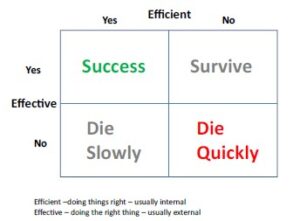
The framework builds upon efficiency/effectiveness (matrix below), first introduced by
Peter Drucker who famously quoted that ‘Efficiency is doing things right and
Effectiveness is doing the right things’. In a business environment, this often translates into efficiency being internal (e.g. processes and procedures) and effectiveness external (the right offerings to the right markets for example).
Source: Shipley, 1998
Within current environments, efficiency and effectiveness are very closely linked to the economic and environmental constraints or opportunities that a business has. Employees are, of course, vital to the success of the other areas. As Richard Branson famously said ‘Clients do not come first. Employees do. If you take care of your employees, they will take care of your clients.’ A business’ workforce will determine and implement strategies to improve efficiency and effectiveness from both an operational and environmental perspective leading to a sustainable entity. Before reviewing the 5 E framework it is important to think about the overarching environments that businesses today inhabit.
The Business Network
Businesses do not work alone. When determining the move to Net Zero and organisational longevity, suppliers, partners and customers need to be taken into consideration along with other stakeholder groups. The terms supply or distribution chains imply linear entities, whereas in reality they are a complex network of organisations. The terms supply/distribution chains and networks are therefore interchangeable within this paper.
Customers can encourage suppliers to develop offerings that have a lower carbon footprint, such as recycled packaging or yarn made from recycled plastic (which can be seen in some clothing – particularly children’s – sold by many chain stores). A small innovation from each supplier will have a big impact on the environmental sustainability of a business. And, on that business’ customers. If every company within a supply chain becomes a little more environmentally sustainable, the final offering to the end customer/consumer will have a much lower carbon footprint (and may also be cheaper to produce).
Including environmental innovations within marketing messages can have the side benefit of improving supplier/customer relationships, brand image and increasing the bottom line. These will further improve business sustainability through increased customer lifetime value.
Rethinking supply chains through steps taken to produce a product can positively impact the miles taken to deliver even a simple product. For example, a pair of jeans, which has an estimated 40,000 miles within all of the value streams needed. This also increases risk (through all of the component part movements) which impacts business sustainability, as well as environmental sustainability from the carbon footprint (Dull, 2025, p4).
These long, complex supply and distribution chains are leading to inefficiencies through waste, extra processes and increased carbon footprints. Circular supply chains are increasingly being viewed as a way to a more efficient and effective global business environment. These chains aim to make the best use of all materials for as long as possible to reduce, repurpose, reuse and recycle, through a series of loops. Therefore, product design and supply chain design need to work together (DeSmet, 2024, p199).
However, each organisation within the chain needs to play their part equally – which can be challenging should there not be the appropriate level of communication, willingness and trust.
This is where the 5 E framework can be of value, not just within individual businesses but across stakeholders in the network. The following sections aim to explain this easy to use framework.
Efficiency
This is usually where businesses start when they are looking to improve their bottom line. In today’s world, not only should processes and procedures be lean, but they also need to be environmentally sustainable. These link closely to efficiencies across the entire supply chain – or business network. The advent of circular supply and distribution chains lend themselves to internal efficiencies through recycling, reusing and reducing waste. Which of course is the central tenet of the circular economy.
It is clear that efficiencies made should not negatively affect the customer experience, however, good relationships with stakeholders across the network will aid development of efficient processes that go across individual company boundaries. Logistics is a clear example of this with reverse logistics becoming more important for sustainability (Grant et al, 2023, p27).
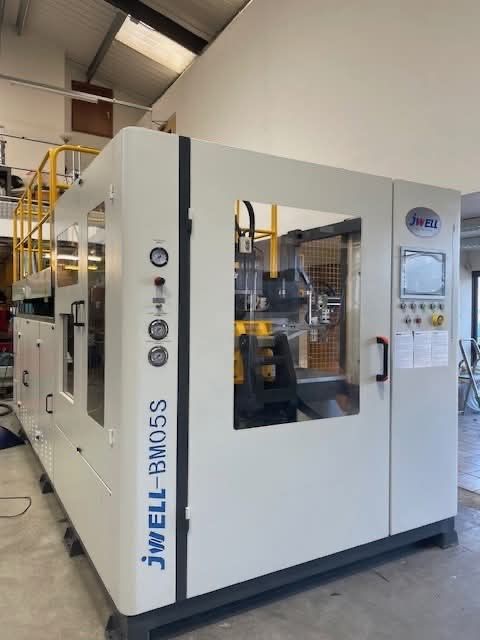
An example of efficiency within a business is a Welsh blow moulding company that recycles polymer trimmings in with virgin polymers. This not only reduces waste and saves money, but also results in an improved product. A further benefit is reduction in carbon footprint not only for the company but for the customers buying the products, improving environmental credentials and marketing messages.
Are your processes and workflows as lean and efficient as they can be? Particularly between departments and supply chain contacts. Can your waste be repurposed elsewhere in-house, or in your supply or distribution chain?
Are other parts of the business as efficient as possible and so saving money and energy?
Environmental
There are many ways that the environmental aspects of a sustainable business can be approached. The circular economy principles have already been mentioned, which link closely with efficiency. The simple aspect of making sure that lights and computers are turned off saves money and energy usage. So, this is the area to tackle first.
Once this is done, investigations into other areas such as electric vehicles, solar panels or wind turbines can be done. These can be costly with no monetary savings seen for years, but they help with the carbon footprint of not only the company but the company’s products – which will help when marketing them down through the distribution network.
All carbon footprint savings help others in the network. The use of recycled materials is a good example of this, as is developing products with an understanding of how they are not only used but also disposed of. The marketing team should be involved with this so that they can develop the correct marketing strategies to help the sales team and the distribution network.
By improving your business’ environmental credentials, you are not only developing more environmentally friendly products, but giving your customers help in developing their own environmental strategies. This should help to increase customer lifetime value so that marketers can concentrate on keeping customers rather than having to recruit many more new ones (which is far more costly).
We cannot forget ESG (Environmental Social Governance) at the point. This is increasingly complex, and it is crucial for businesses to have a comprehensive approach to these regulations. Particularly as they can differ significantly between countries (Taticchi and Corvaglia-Charrey, 2025, p12).
There are many examples of environmental implementations, one being an electrical and plumbing contractor based in mid-Wales who is replacing their vehicle fleet with electric vans.
How developed are your environmental credentials? How involved are the marketing team in getting the right messages to market and ensuring that customers know that your improved environment will help their carbon footprint and messages?
Effectiveness
This is closely related to the development of environmentally friendly offerings and appropriate marketing strategies for them. Managing customer relationships is critical to this area, as is developing the right messages to market.
Again, supply chain/business network knowledge and relationships are vital for delivering what the market needs. But at this stage in the global climate change push, there is often a stage of education rather than simple marketing to get buy-in. For example, recycled polymers are getting more traction in the market but bio-polymers are still behind them in market acceptance.
Research has shown (Abbott 2018) that when introducing new concepts to a market, acceptance is not always instantaneous. The higher the involvement and risk level of a new product or service, the longer it takes to gain that acceptance. The framework below shows the stages that acceptance can take and therefore the type of approach needed to move customers (and other stakeholders) along the continuum. Starting with education for those with no knowledge and moving across with a mix of marketing and education (for the sceptics and those accepting) into what would be typical marketing practices for the company for customers who are willing to buy.

Source: (Abbott, 2018)
So, although innovation is critical to an organisation’s sustainability (both environmental and business), it has to be the right innovation in order to be truly effective. We are in the midst of VUCA (Volatility, Uncertainty, Complexity and Ambiguity). Because of this planning and strategizing become more important than ever (North, 2024, p68). Horizon scanning is an approach used by many organisations today and the ‘old stalwart’ frameworks such as PESTEL are still used to good effect to help organisations bring appropriate sustainable innovations to their markets in today’s complex competitive environment, so that they can compete effectively.
An innovative and effective example is that of a small Welsh glamping company that has upcycled and re-used everything from horse trailers to kitchen units to deliver a truly unique holiday experience for customers. Set in a rewilded environment, holidaymakers can enjoy birdsong and bluebell woods from their own tents or the company’s shepherd hut and geodomes.
How effective is your organisation? Are you delivering what your customers need? Can you deliver offerings that they don’t know they need yet? Are your marketing messages working to improve your image and reputation?
Economic
This area is very closely linked to efficiency and effectiveness. Organisations need to be both for economic success (as the framework above outlines). In today’s society environmental concerns drive the economy as a whole, and therefore business longevity for companies.
This links back to innovation – as Peter Drucker famously quoted: “The two essential functions of business are innovation and marketing as these are the only two areas that drive profit. All others are cost centres supporting the profit drivers”. Therefore, the effectiveness section of the 5 E’s becomes one of the key areas within the framework as (along with the employees) it drives the business forward allowing for economic growth.
The triple bottom line (People, Planet, Profit) therefore is a key strategic driver when planning. Using this as the focus for longer term goals as well as shorter term objectives, enables organisations to embrace environmental sustainability (within ESG regulations) to deliver against profit targets.
A small but fast-growing Welsh specialist storage business uses 95% local suppliers. This included recycled materials for their products and packaging. The aim is to keep the local economy growing and stable as well as keeping their carbon footprint as low as possible.
Does your business strategy include the triple bottom line? Is there room for more efficiency within the business without adversely affecting innovation and effectiveness? Can the business harness environmental sustainability for economic growth through the supply chain?
Employees
Employees are central to a business. Each person has a slightly different view of the company, based on their role. These views should be harnessed so that each department runs in the most efficient and effective way, interacting with adjacent areas seamlessly for smooth, lean workflows.
Interaction is important and so internal marketing is as important as getting the appropriate messages out externally. As David Packard (from Hewlett-Packard) said: “Marketing is too important to be left to the marketing department”. All employees should be ‘on-message’ and ‘on-brand’ as they can act as marketers themselves to develop company identity and image and therefore build reputation. They also will have ideas that should be captured to help further help the business become more effective and efficient.
Part of the messages should be the vision and mission or purpose of the company. They should be clearly defined and all employees aware of what they are working towards. It also helps with retaining people, recruiting the right people and driving innovation (Taticchi and Corvaglia-Charrey, 2025, p48).
Innovation doesn’t just come in the form of new offerings to the market; it can be new ways of approaching internal tasks as well as interactions with the business network.
Measures and controls across the company can be used to ensure that it is a learning organisation, constantly improving workflows and outputs in a continuous improvement cycle. Circular economy principles are critical here for improved environmental and economic sustainability. The PDCA cycle (Plan, Do, Check, Act) is one that is often used, along with Kaizen, Just in Time and other well-known process improvement tools.
One example of employee engagement is that of a Welsh automotive business that has worked a 4-day week for years. This has reduced employee attrition, sickness and improved productivity. Employees are actively encouraged to volunteer ideas and new ways of working, especially around innovation and workflow improvements.
Are your employees engaged in the sustainability process? Do they understand the vision and purpose of the company? Is there a clearly defined vision and mission statement? Are employees encouraged to share their ideas?
Conclusion
This short paper has just scratched the surface of ensuring that environmental sustainability can aid business sustainability. Hopefully it has given an overview and raised questions to be answered within your business. The 5 E’s framework was developed to enable business owners and senior management teams to focus on key areas when going forward within the ‘VUCA’ world that organisations inhabit today.
One point that stands out, is that given the mount of change within all environments, businesses need to look forward strategically and ensure that they have firm plans in place to allow them to achieve long term goals. Otherwise, companies will become tactical and short term focused, following the market rather than proactively delivering change. How far out does your business look? It should be a minimum of 10-15 years.
The use of value chain frameworks is useful for strategy development. Michael Porter’s value chain (Porter, 1980) is famous for looking internally at how a company can be efficient to drive margin. The CRM Value Chain (Buttle et al, 2023) reviews the external customer base to drive long term customer lifetime value. These frameworks, when used together can aid a business to deliver on-going competitive success. Combining these with the sustainability value chain (Jones, 2025) will help deliver both business and environmental long-term sustainability. But that is the subject of another article!
References
Abbott J (2018), Marketing the Rural Entrepreneur: A Case Study of Equine
Complementary Therapists, Unpublished PhD
Buttle F, Jones J, Stone M (2023), The CRM Value Chain – An Overview, Customer Think, The CRM Value Chain – an Overview | CustomerThink
DeSmet B (2024), Rethinking Supply Chain: Build a strategy-driven, sustainable and resilient supply chain, Kogan Page, London
Dull D (2025), Circular Supply Chains: How to Build the Future of Sustainable Operations, Kogan Page, London
Grant DB, Trautrims A, Wong CW, Sustainable Logistics and Supply Chain Management: Principles and practices for sustainable operations and management, 3rd Edition, Kogan Page, London
Jones J (2025), The sustainability value chain, unpublished article
North J (2024), Leading Sustainable Innovation: A roadmap for technical environments, Kogan Page, London
Porter M E (1980), Value Chain Analysis, Oxford Press, London
Shipley D (1998), Chartered Institute of Marketing Course notes, IBM Business School
Taticchi P, Corvaglia-Charrey M (2025), How to be Sustainable: Business strategies for leading change, Kogan Page, London
AUTHOR BIO
Dr Julie Jones is a Chartered Marketer and Fellow of the Chartered Institute of Marketing. Prior to working in academia, she had a long career in IT and Marketing. Mainly in manufacturing (automotive and high tech), working as a systems engineer and then leading an international marketing team for a global blue-chip. She ran her own business consultancy, helping SMEs grow their businesses strategically. Her specialisations are strategic planning and developing customer lifetime value. Today she lectures in marketing strategy, global marketing and customer relationship management. Her research interests include environmental sustainability and rural business networks. She still works in industry, holding directorships in manufacturing and hospitality organisations and is part of CEIC (Circular Economy Innovation Communities) in Wales.